
THE LIFETIME ACHIEVEMENT
By Günter Dollhopf
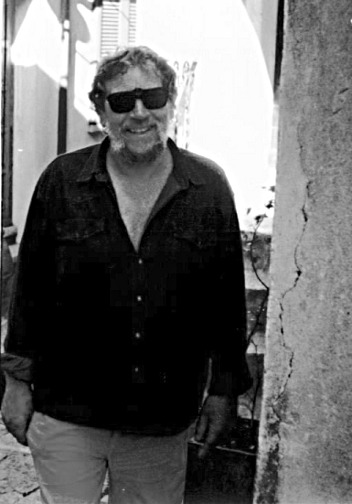
To reliably evaluate an artist’s oeuvre is only possible 30 years after his death, according to the art historians. Since Fritz Hagl died in January 2002, an appreciation of his life’s work would then be premature.
Therefore, only the fact that I am not an art historian affords me the chance to write about his work today and to represent the value of his paintings. Being a painter myself, I had the good fortune to have been able to follow Hagl’s work over the course of many years, in a partly critical, partly encouraging and admiring friendship.
From 1970 I visited his studio on the island of Elba regularly, every year, and was therefore able, at least partially, to follow the evolving process of production. I am less concerned here with historical or stylistic comparisons than with the creative contexts of origination.
Because artists are entitled to the privilege of ego-centricity, I (being an artist myself) dare to employ a subjective view, based on my own visual thoughts and actions. Only from such a personal viewpoint is it possible to find an approach to Hagl’s paintings, because throughout his life he steadfastly refused to be subjected to “objective” comparison. He never exhibited his work comprehensively in public, with one exception in his last year of life. With the awareness that painting is the grand design and mission of life, he withdrew from the art market out of inner conviction and necessity.
Thus he realized the demand of Dürrenmatt, who, in a speech on the occasion of being awarded the Bern Prize for Literature in 1979, asked: “Whoever does not see to it in time that he gets out of the cultural chatter will no longer get around to working, and thus not to himself; and to arrive there, rather than at some literary fashion, should really be the goal of every endeavour. Only the one who has come to himself is able to undertake what is laid upon him: to master the world, to give it a meaning through himself.”
The power of Hagl’s personality lay entirely in the fact that, unspectacularly, he relied on the inherent strength of his paintings and not on their staging. With this attitude he was an outsider in the world of merciless self-representation at the end of the twentieth century.
Out of the self-evidence of this attitude there stands before us an oeuvre of impressive consequence and completeness, whose magical content points towards another, deeper level of being. “I paint for God,” Hagl once said to me when, in the mid-seventies, I asked him the reason for his refusal of publicity. Only now, after the socio-political turbulence of those years has died down, can the meaning and sense of this astonishing answer be understood.
The early work: 1958–1974
The first thing I saw of Hagl’s was a portrait from 1958: a man with a cap, green scarf and blue-black jacket, in a slightly forward-leaning posture, his gaze directed at the viewer; the crossed hands, with brown shadows and highlights, lead diagonally to the lower right. Such portrait studies always seem to stand at the beginning of an artistic life’s path. I too had toiled over such efforts at the start of my own studies. Out of that frustration, the painterly quality of the picture and the particularity of the human expression in the sitter’s face escaped me at the time. (Fig. 1)
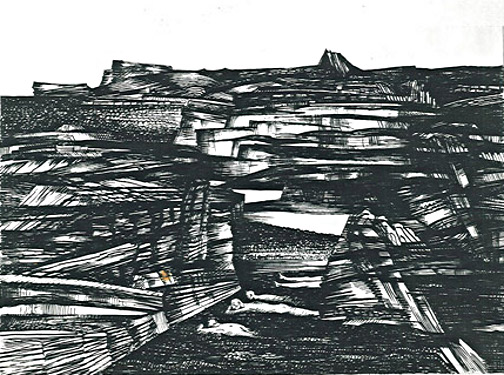
The drawings, executed in pen, pencil or chalk, have a powerful effect and are marked by a strong will. They orient themselves to the nature of the island, rendering the macchia, rocks and houses. Something quite of their own speaks from them, something that seemed to lie in the nature of this strong man: the attempt to fit it into a canon of forms that Hagl believed he could discover as a synthesis in the visible shapes. These are not nature studies in a purely representational sense, but creative processes in a transposed manner. The confrontation between subjective imagination and the seeing of the object, the duality between personal idea and natural form, are clearly conveyed. (Fig. 2)
On Elba, Hagl had first built his house from 1960 to about 1963, drawing in between and afterwards. Only after setting up his studio could he venture into more long-term painting projects.
The tempera landscapes created between 1965 and 1970 appear more abstract, further from nature than the drawings made out of doors. In these “ideal landscapes” one can discover the depiction of mythical ideas, expressed in the particular way nature is transformed and in the appearance of strangely stylized human beings who populate these utopianly tiered rock formations. A “gallery tone” sustained in red-brown prompted my superficial response during a studio visit in those early years. “Academic” was then the verdict of an immature pseudo-revolutionary who had only recently accepted a professorship at the Nuremberg Academy of Art and, in that guise, paradoxically claimed to want to paint against academism. (Fig. 3)
The middle years: 1975–1988
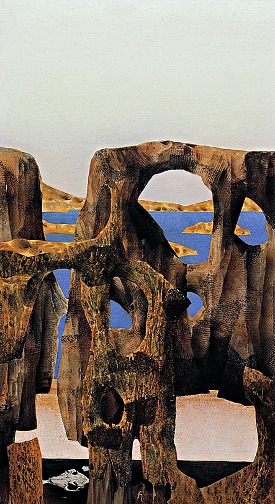
After 1975 a decisive change took place in Hagl’s paintings. Our meeting in the summer of 1976 is as vivid to me today as it was then; the feeling of astonishment, joy and excitement is equally present.
Beside several medium formats on the walls of the studio, a small picture stood on the easel, depicting sea, sky and rocks. (Fig. 4)
It is of a technical and painterly mastery that is realized constantly in Hagl’s pictures from then on. Everything schematic, rigid and half-baked has vanished and gives way to a new pictorial self-evidence. An expanded formal conception, an altered awareness of reality, combined with clear, bright colour, gives these new pictures radiance and a credible artistic vitality. Equally binding to them is Hagl’s invention of a particular spatial layering. He now places, in front of the differentiated landscape parts of sea and mountains, scenery-like formations of rocks or human and animal bones. These interlockings of club-like masses of form, articulated on two or three planes, are connected in such a way that they can be read as a closed spatial web. In and between them open cave-like curves, oval and variously shaped rectangular openings that, like vistas or breakthroughs, leave free the landscape formations and seas lying behind.
Pictorially this happens in such a way that a reversal of the usual spatial understanding takes place. The front spatial backdrop optically recedes through shading, while lighter forms lying in the background press forward into the foreground as vistas. Both “planes” thus meet on the same “picture plane”.
In this way Hagl succeeds in bringing together parts that do not belong together in terms of spatial perspective: a presentness despite the difference of distances, a simultaneity of the non-simultaneous. Through the continuum of the present an aura of the meditative arises, conveying to the participating viewer the sensation of time standing still.
These paintings of Hagl’s are of a dreamlike beauty. They transform shapes of visible reality and lead into a visionary world of images. Perhaps their secret lies hidden in that shift of space and time described above. (Figs. 5, 6, 7)
As art history attests, both the drawing of spatially distant objects into the picture plane and the shaping of negative forms have already been demonstrated by other artists. In a painting by Paul Cézanne, for instance, a house that in reality stands far back appears in the foliage of the foreground right beside it. In paintings by Max Ernst, the light blue of the sky penetrates through the branches of the trees as a deliberately formed wedge-shaped slit. Round and oval forms come forward in these pictures as gaps between bushes and shrubs.
With Fritz Hagl, however, the negative forms are painted out in an object-related way, like independent “pictures within the picture”. The close contact with the nature of Elba makes them so especially characteristic. These “concetti” henceforth become the ever-recurring surprises of each of his new paintings. Despite his pronounced tendency toward strict pictorial construction and considered composition, his procedure always feels alive, for “through the observation of nature Hagl arrived at the organic forms, which over the years became ever denser.”
A further feature of Hagl’s compositional technique is the “carrying through of the lines”, the connection of contours as a linear web through the whole picture. People or objects do not stand isolated within the square of the picture but are woven together into a great ornament. He discovered this mode of representation in the late seventies while studying the old masters. In the pictures of the late work it becomes the dominant manner of design. “See how the lines run through,” he once said to me as we looked together at a fresco by Benozzo Gozzoli in Florence, tracing in the air the connecting lines of heads, garments, horses, houses and plants.
The late work: 1989–2001
Whereas until now people or animal figures were still sometimes woven into the picture, from 1989 the figure leaves the scene and that interwoven wall of rock formations and vegetative elements grows, filling more and more the entire format.
In terms of technique Hagl now works with a wide variety of means and the highest precision. In a small workshop-like annex in front of his house he prepares his grounds. He covers pressboard panels with canvas or cotton cloth and coats them in several layers with a self-made half-chalk ground. Over this, in the studio, he paints the rough colour layout in egg tempera. After an intermediate varnish of dammar resin and turpentine, egg-tempera glazes are applied to model the objects. He now occasionally also uses ferns and lichens, through whose framework he sprays coloured inks or diluted egg tempera onto the surface. In this way he achieves multi-layered graphic structures and can enliven and shade in greater detail forms previously laid in flatly. After further glazes, overpaintings and intermediate varnishes comes the final varnish, also as protection against the moist, salty island air. The pigments come from an old colour technician in Munich or from the coloured earth hills of Elba. I often dug ochre, sienna or red tones with Hagl, which we then burned into deep red or violet. This whole procedure of old-masterly picture-making is lengthy, but a part of Hagl’s philosophy of life: he made his pictures as “a gardener lays out his garden,” from the careful tending of the soil to the harvest.
In 1989 a small format with stone forms, sea and sky appears, whose picture grid is still ordered in spatial depth planes. (Fig. 8) Soon afterwards, however, the painted surface becomes overgrown and those perforated, filigree-structured rock walls appear that close off the depth of the picture. (Fig. 9) They are modelled on the rocks at the beach of Nisporto, but also remind me of aerial photographs taken from a great height. (Fig. 10)
The single picture no longer suffices for Hagl. He paints triptychs, groups of four or six. A four-part series in red tones is now bounded flatly. Every illusion of space into the perspective behind is barred. As if painted on panels or curtains, the stone scaffolds lie directly before us. These structures present themselves in small spaces in an extremely differentiated way and reveal, in these little spatial cells, the whole richness of Hagl’s art. (Figs. 11–14)
Micro- and macrocosm are to be united. The detail radiates the same intensity as the overall composition on the large scale. I can still see Hagl before me, cutting passe-partout fields of various sizes out of cardboard and using them to examine his paintings from different distances at every possible part.
In his last, unfinished picture Hagl returns again to larger depth-spaces, as if the horizon-obstructing walls were to be pushed away again. (Fig. 15) Sky, sea and coast again appear in spacious guise. Rocks are already painted out, the blue surfaces of sky and sea only laid in as to colour and structure. The further path remains unanswered.
Fritz Hagl loved music, jazz. He knew several musicians personally. Some were his guests on the occasion of the festivals on Elba. So let the guitarist Dean Brown be quoted at the end, whose statement could also stand over Hagl’s work: “… the decisive criteria in music, as in every other artistic product, are integrity, expressiveness and warmth.”
(Translation: Karl Hans Berger, musician)